Pro Sports 2860 Cat: Building the Perfect Surf Photo Boat
Pro Sport 2860 Cat: Top surfing photographer builds his dreamboat.

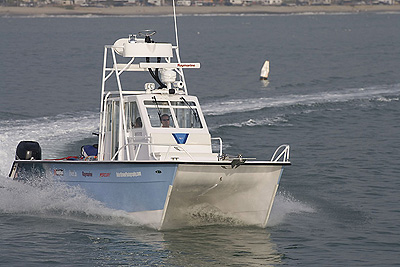
Shown at Todos Santos, a big-wave surfing spot in Mexico, the 2860 Cat from Pro Sports Boats took a pair of two-man surfing teams, three personal watercraft, Brown and a friend to Cortes Bank, which is 100 miles off the Southern California Coast. (All photos by Robert Brown, Copyright 2004)
Not many people can say they love what they do for a living, so I guess I'm pretty lucky. I'm a professional photographer, one who grew up surfing off Southern California. I've done commercial catalog and brochure work for companies such as Yamaha Watercraft, Sea-Doo, Tommy Bahama, Red Bull and Polaris, but my passion is shooting surfers riding the largest waves on the planet. My photos have appeared in Surfing and Surfer Magazine as well as nearly every other publication you can think of. Last year, I was even fortunate enough to have a two-page spread of Laird Hamilton riding a monster wave at Jaws on Maui in Sports Illustrated. I definitely love what I do — it's a rush to capture surfers, many of whom are my closest friends, riding giant waves.
But doing the job takes a lot more than tens of thousands of dollars in photo equipment, which, of course, I have. It takes a special powerboat that can reach surf spots that are far from shore. In the most extreme case, a spot called Cortes Bank off San Diego, that means 100 miles each way.
For this year's big-wave season, which technically began in November 2003, I had a new catamaran built. My goal was to find a cat that could accommodate two four-stroke outboards and be fuel-efficient enough to handle a roundtrip Cortes Bank photo shoot on one tank of fuel. That's a tall order, considering that I had my new boat, a Pro Sports Boats 2860 Cat, outfitted with a ramp system for a full-size personal watercraft we use as a rescue craft in heavy surf. I also tow a pair of personal watercraft, which two-man teams of surfers use to tow themselves into giant waves (waves of this size are too large to paddle into — they simply move too fast) behind the boat, all their boards and gear and my photo equipment. (I've since found that I do need to carry a bit of extra fuel given all the added weight to the boat, as well as extra fuel for the watercraft, but not much.)
If You Build It
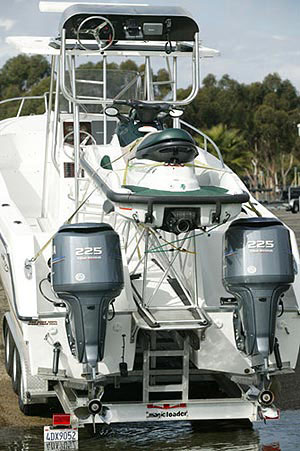
Twin four-stroke Yamaha outboard engines, flanking a unique personal watercraft retrieval system, provided power for the boat.
I looked at several boats, but the Pro Sports Boats 2860 Cat was my top choice for a number of reasons. First, I test drove one at the company's plant in Alabama, which is about an hour and a half West of Atlanta and within a couple miles of the famed Talladega Motor Speedway, and I loved it. Second, a center console layout without cuddy was exactly what I needed — surf photography from a boat requires lots of open space. Third, the boat had a 9'8" beam, which made for a wide and stable platform that's a must for a photo tower.
Pro Sports installed two new Yamaha 225-hp counter-rotating four-stroke outboard engines on the transom. I also ordered Yamaha's dual station rigging kit, as I need an upper driving station on the tower.
To build that collapsible tower with a T-top, as well as the watercraft ramp system, I hired Jeff Lewis of Precision Fabrication in San Clemente, Calif. (Lewis is a Chevy-sponsored off-road race truck driver and he not only drives the trucks, but he builds them.) The project took seven weeks, and it definitely was worth the wait. I wanted the tower to lay flat, quickly and easily, for towing. The way Lewis built it, removing two bolts is all it takes for that to happen.
For months, I had been looking at boat brochures, ads and the Internet at all the different shapes and sizes of T-tops and towers, and the best way to build them. The fiberglass hardtop I bought from Pro Sports determined the overall size of the top, but there were other required elements. We knew, for example, that we needed twin ladders for the upper station for easy access, support and for helping secure the Warn Winch for the watercraft ramp systems. As designed, the ladders lean inward for easy climbing and reinforcement of the tower in rough conditions.
Once the tower was built, I dropped the boat in the water to test it for strength and vibration, as well to break in the engines. For the sake of appearance, we had omitted the front crossbars for the windshield. We immediately found out why every marine fabricator uses them — rocking in rough water puts too much force on the windshield area to leave out those crucial supports. Back to the shop we went and added the needed crossbars
Knowing the boat could see some seriously rough conditions, we decided to add two additional removable supports from the aluminum ring under the hard top down to the gunwales at the front of the tower on each side. The additions might have been overkill as the tower was rock-solid without them, but I wanted to remove all doubt of what the boat could withstand. Lewis made these bars removable with pin pad combos, so when I'm fighting a gamefish and it moves me all over the boat — I'm also diehard fisherman — I can get anywhere I need to be without obstruction.
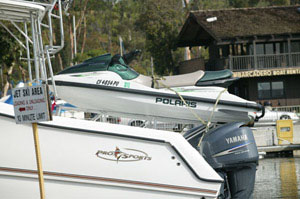
The ramp system was designed to carry a rescue craft, on this trip a model from Polaris.
For electronics, I selected equipment from Raymarine as I have used them in the past and I'm familiar with their systems. I installed a 48-inch open-array radar antenna with 10-inch daylight viewable color screen and autopilot, as most of these trips to and from Cortes Bank are at night. My VHF radios are from Icom. Of course, I needed some good music so I went with a Kenwood system and Kenwood amp with four waterproof speakers from West Marine. Sirius satellite radio was a must and the signal is incredibly clear, even 100 miles out in the open ocean.
Four new Optima Marine batteries power the entire system, which I rigged myself. I also rigged the upper station steering system. (You'd be amazed how much wire and hydraulic line that takes.)
The Acid Test
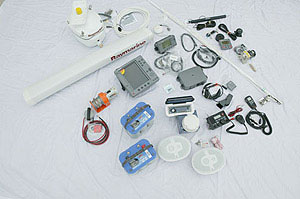
Because Brown usually runs to Cortes Bank after dark, he installed a 48-inch open-array radar antenna with 10-inch daylight viewable color screen and autopilot from Raymarine.
After completing the boat, I met with representatives of Billabong, a major surf wear manufacturer, and discussed being on retainer with them for their big wave search called "The Billabong Odyssey," a three-year search for the biggest waves in the world. (Go to www.billabongxxl.com to read all about it and see the recent photos.) They hired me for the winter to be on-call to take their surfers out to Cortes Bank should the weather and waves align to make the conditions for giant waves and light winds ideal. I figured I'd be waiting months, if not years, for all those variables to align.
Not so. On December 12, 2003 a storm was coming together in the North Pacific. The storm had the required wind direction with wind speeds in the 60-knot sustained range (near hurricane strength), and there was a real possibility of surfing-ideal Santa Ana offshore winds. It looked like, if everything held, based on the weather model, Cortes Bank could be huge — and perfect. I received my first email warning of the possibility of the swell from Sean Collins, who owns www.surfline.com and is the world's leading authority on wave-weather forecasting.
The boat was ready, but this gave me enough lead-time to finalize my preparations. I was in contact with Billabong Odyssey surf veterans Mike Parsons and Brad Gerlach, as well as young guns Greg and Rusty Long. I had seen Greg and Rusty surf giant waves, and Greg had just recently won the Red Bull Big Wave event in South Africa so I felt it was time for them to try the next level if they were up to it. They were excited to be a part of it so we waited and had Collins advise us on our next move.
Based on Collins' advice, we left at 7 a.m. on Wednesday, December 17 and we could see the waves 16 miles away from the bank. The surfers were in the water by 1 p.m. and surfed 40-footers until dark. I used my satellite phone to call Collins and, as he'd suggested in an earlier conversation, he wanted us to stay overnight. More big surf was coming.
We moved the boat about five miles from the bank's reef, had some great laughs and a cold dinner. The surfers were asleep by 8 p.m. and did not budge until 6 a.m. We awoke to the amazing site of being in the middle of nowhere, out in the open ocean with no land in sight, with a giant groundswell rolling under the boat.
When we reached the bank, we could hardly believe what we found — perfect waves, caressed by offshore breezes, up to 60 feet tall. The boys attacked the huge surf from 7 a.m. until 2:30 p.m. without stopping. I called Collins one more time to confirm we had gotten the best of the swell and we could head home, as film and fuel were becoming scarce. He said we'd been there for the best of it, and should head back.
Mike Parsons and Rusty Long elected to ride the watercraft for a while so I would not have to tow them. That was strong work considering they'd surfed huge waves all day. But the ocean conditions were so perfect they ended up riding the watercraft the entire way home with a couple fuel stops on the way. My boat ran an easy 45-mph in oil-glass water with a watercraft on its ramp in the back, all our gear and the four people. We all made it home safely just after dark.
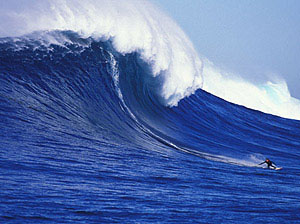
In snagging this estimated 60-footer, Greg Long rode one of the largest waves of the season to date.
Greg Long has since become famous in the surfing community for riding a wave that day estimated at 60 feet. My Pro Sports 2860 Cat performed beautifully and it was the perfect choice for my work. The upper driving station enabled me to shoot from a higher position, and I didn't miss any shots because of the large humps of water that have, in the past, blocked my photo angles.
Now I'm back to waiting, waiting for the next big swell and the elusive 100-foot wave. I don't necessarily enjoy waiting, but when you love your job as much as I do, it's worth it. And guess what? I just received an e-mail saying to fuel up, another big storm is starting and it might be go-time again.
I love this job.
Editor's Note: Robert Brown also is a frequent contributor to Powerboat magazine. To see more of his work, go to www.robertbrownphotography.com.